
March - May 2026
Saathi
Saathi
Saathi
A semi-humanoid table-bot that explores care not as instruction, but as a system of subtle presence that observes, interprets, adjusts, and responds without intrusion, designed to reduce missed daily care events by up to 83% through continuous, context-aware assistance.
Industry
Industry
Physical AI · Assisted Living
Physical AI · Assisted Living
Scope of work
Scope of work
Product & UX Design
Product & UX Design
Duration
Duration
3 months
3 months
A semi-humanoid table-bot that explores care not as instruction, but as a system of subtle presence that observes, interprets, adjusts, and responds without intrusion.
Industry
Physical AI · Assisted Living
Scope of work
Product & UX Design
Duration
3 months
" Moving into the campus hostel changed something I hadn’t expected. For the first time, I wasn’t around to check on my parents’ medicines and daily routines. What once felt effortless became dependent on occasional calls and reminders. That lingering concern pushed me to think beyond my own situation toward the larger gap between caring for someone and actually being present for them. "
" Moving into the campus hostel changed something I hadn’t expected. For the first time, I wasn’t around to check on my parents’ medicines and daily routines. What once felt effortless became dependent on occasional calls and reminders. That lingering concern pushed me to think beyond my own situation toward the larger gap between caring for someone and actually being present for them. "
" Moving into the campus hostel changed something I hadn’t expected. For the first time, I wasn’t around to check on my parents’ medicines and daily routines. What once felt effortless became dependent on occasional calls and reminders. That lingering concern pushed me to think beyond my own situation toward the larger gap between caring for someone and actually being present for them. "


PROBLEM
PROBLEM
PROBLEM
Medication adherence in elderly care is not just a reminder issue, but a breakdown in everyday decision support.
Medication adherence in elderly care is not just a reminder issue, but a breakdown in everyday decision support.
Medication adherence in elderly care is not just a reminder issue, but a breakdown in everyday decision support.
Most reminder systems work like alarm clocks: they ring on time and assume the job is done. But taking medication is rarely that simple. A person might be exhausted, emotionally drained, busy, or waiting for help. In those moments, even accurate reminders can be ignored or delayed. This creates a gap where information arrives, but the decision to act still feels unsupported. Over time, it can lead to missed doses, stress, uncertainty, and greater dependence on others.
Most reminder systems work like alarm clocks: they ring on time and assume the job is done. But taking medication is rarely that simple. A person might be exhausted, emotionally drained, busy, or waiting for help. In those moments, even accurate reminders can be ignored or delayed. This creates a gap where information arrives, but the decision to act still feels unsupported. Over time, it can lead to missed doses, stress, uncertainty, and greater dependence on others.
Most reminder systems work like alarm clocks: they ring on time and assume the job is done. But taking medication is rarely that simple. A person might be exhausted, emotionally drained, busy, or waiting for help. In those moments, even accurate reminders can be ignored or delayed. This creates a gap where information arrives, but the decision to act still feels unsupported. Over time, it can lead to missed doses, stress, uncertainty, and greater dependence on others.

USERS' POV
USERS' POV
USERS' POV
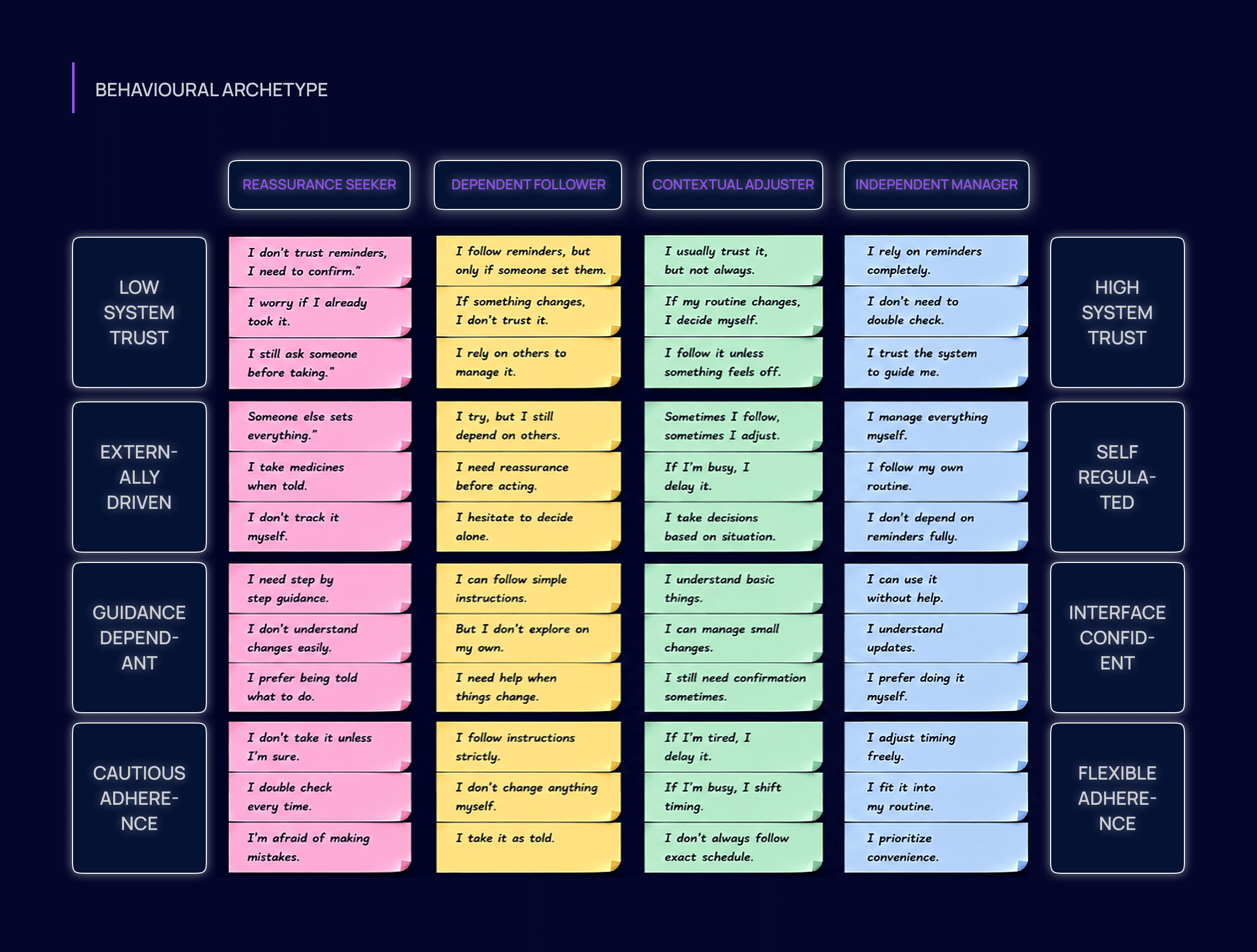
Medication behavior revealed far more than adherence once interviews exposed the emotional negotiations hidden inside everyday care routines.
Medication behavior revealed far more than adherence once interviews exposed the emotional negotiations hidden inside everyday care routines.
Medication behavior revealed far more than adherence once interviews exposed the emotional negotiations hidden inside everyday care routines.
What initially appeared as usability limitations gradually unfolded into issues of trust, reassurance, dependency, emotional readiness, and resistance toward intervention. The interviews helped connect market gaps with human behavior, leading to the emergence of four distinct archetypes shaped by different relationships with care, autonomy, and assistance.
What initially appeared as usability limitations gradually unfolded into issues of trust, reassurance, dependency, emotional readiness, and resistance toward intervention. The interviews helped connect market gaps with human behavior, leading to the emergence of four distinct archetypes shaped by different relationships with care, autonomy, and assistance.
What initially appeared as usability limitations gradually unfolded into issues of trust, reassurance, dependency, emotional readiness, and resistance toward intervention. The interviews helped connect market gaps with human behavior, leading to the emergence of four distinct archetypes shaped by different relationships with care, autonomy, and assistance.
PERSONA BOT
PERSONA BOT
PERSONA BOT
Care patterns became easier to decode once user behaviors were experienced through conversation instead of static documentation.
Care patterns became easier to decode once user behaviors were experienced through conversation instead of static documentation.
Care patterns became easier to decode once user behaviors were experienced through conversation instead of static documentation.
Using a chatbot format made differences in reassurance needs, hesitation, dependency, emotional comfort, and response to intervention feel more visible through tone, dialogue, and interaction flow. This helped surface how differently users negotiate care within the same medication ecosystem.
(Couldn’t resist trying vibe-coding somewhere in the process too.)
Using a chatbot format made differences in reassurance needs, hesitation, dependency, emotional comfort, and response to intervention feel more visible through tone, dialogue, and interaction flow. This helped surface how differently users negotiate care within the same medication ecosystem.
(Couldn’t resist trying vibe-coding somewhere in the process too.)
Using a chatbot format made differences in reassurance needs, hesitation, dependency, emotional comfort, and response to intervention feel more visible through tone, dialogue, and interaction flow. This helped surface how differently users negotiate care within the same medication ecosystem.
(Couldn’t resist trying vibe-coding somewhere in the process too.)

DESIGN GOAL
DESIGN GOAL
DESIGN GOAL
Medication support needed to move beyond rigid reminder systems that fail to adapt to the unpredictability of human behavior.
Medication support needed to move beyond rigid reminder systems that fail to adapt to the unpredictability of human behavior.
Medication support needed to move beyond rigid reminder systems that fail to adapt to the unpredictability of human behavior.
The intention was to build a Physical AI ecosystem that calibrates assistance through behavioral context, emotional readiness, physical state, and autonomy sensitivity rather than approaching adherence through repetitive reminder logic alone.
The intention was to build a Physical AI ecosystem that calibrates assistance through behavioral context, emotional readiness, physical state, and autonomy sensitivity rather than approaching adherence through repetitive reminder logic alone.
The intention was to build a Physical AI ecosystem that calibrates assistance through behavioral context, emotional readiness, physical state, and autonomy sensitivity rather than approaching adherence through repetitive reminder logic alone.

HUMAN-ROBOT INTERACTION (HRI)
HUMAN-ROBOT INTERACTION (HRI)
HUMAN-ROBOT INTERACTION (HRI)
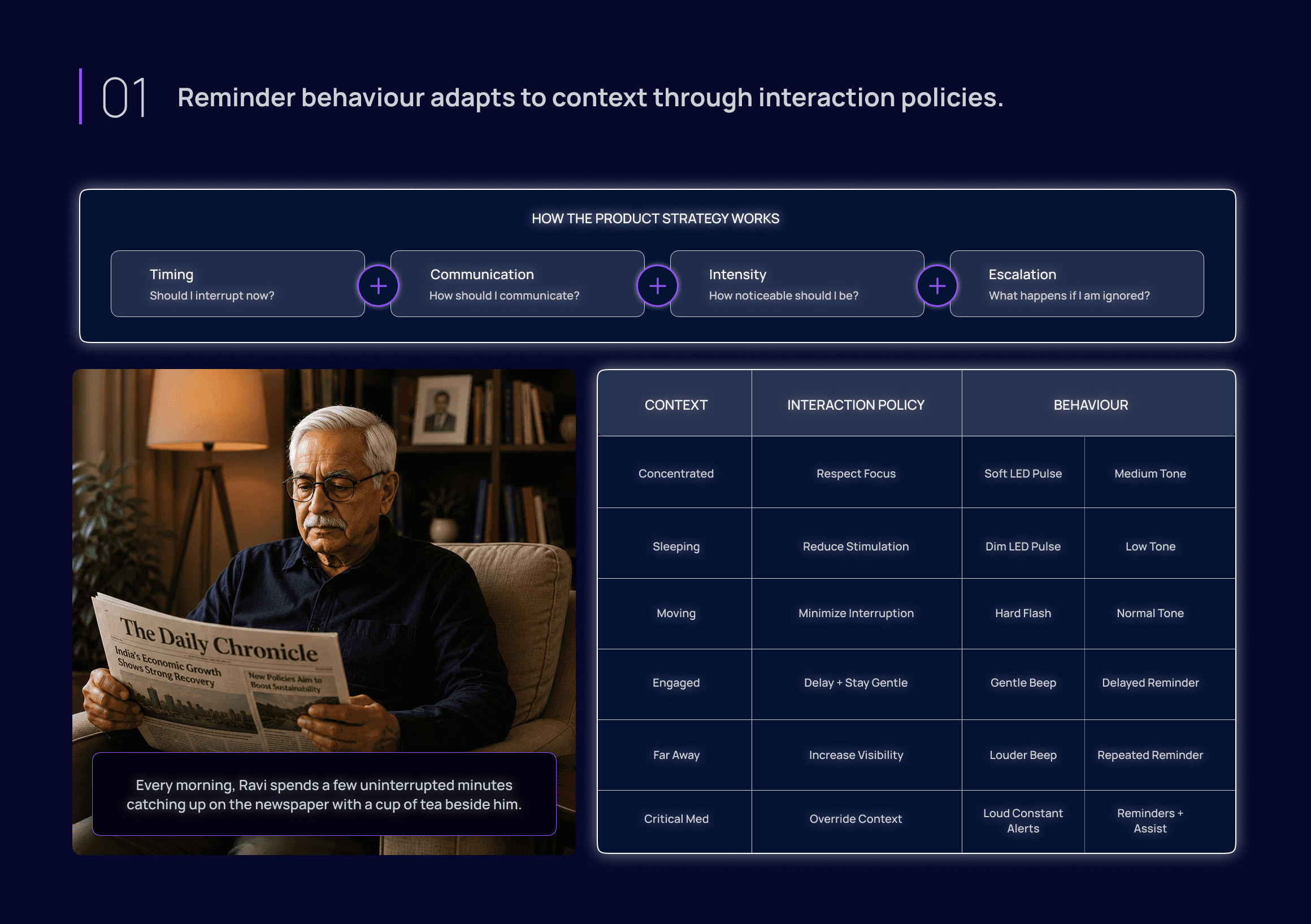
Assistance was designed to emerge from perception, interpretation, and context rather than predefined actions alone.
Assistance was designed to emerge from perception, interpretation, and context rather than predefined actions alone.
Assistance was designed to emerge from perception, interpretation, and context rather than predefined actions alone.
Different sensing layers, behavioral inputs, contextual triggers, and assistive outputs were explored to understand the flow of information behind every interaction. This framework established how the system would transform observations into decisions and decisions into adaptive support, creating the foundation for the behaviors later experienced by users.
Different sensing layers, behavioral inputs, contextual triggers, and assistive outputs were explored to understand the flow of information behind every interaction. This framework established how the system would transform observations into decisions and decisions into adaptive support, creating the foundation for the behaviors later experienced by users.
Different sensing layers, behavioral inputs, contextual triggers, and assistive outputs were explored to understand the flow of information behind every interaction. This framework established how the system would transform observations into decisions and decisions into adaptive support, creating the foundation for the behaviors later experienced by users.

BRAINSTORMING
BRAINSTORMING
BRAINSTORMING
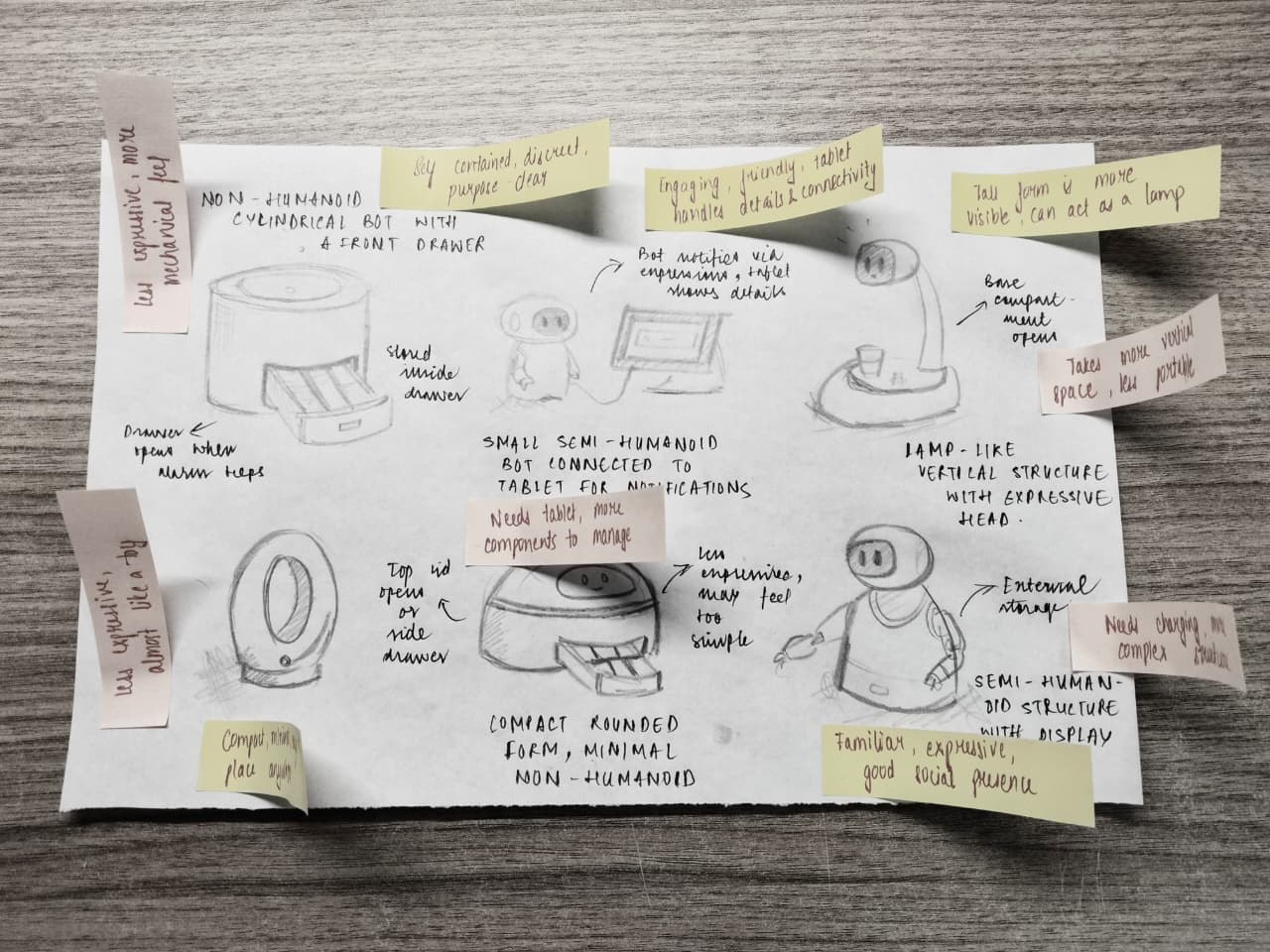
The earliest concepts questioned how care should physically appear, behave, and occupy space within everyday life.
The earliest concepts questioned how care should physically appear, behave, and occupy space within everyday life.
The earliest concepts questioned how care should physically appear, behave, and occupy space within everyday life.
Multiple embodiment directions were explored across visibility, emotional presence, movement behavior, interaction complexity, and spatial footprint. The explorations helped identify which forms felt approachable and socially comforting versus mechanically distant, visually intrusive, or operationally overwhelming within a home care environment.
Multiple embodiment directions were explored across visibility, emotional presence, movement behavior, interaction complexity, and spatial footprint. The explorations helped identify which forms felt approachable and socially comforting versus mechanically distant, visually intrusive, or operationally overwhelming within a home care environment.
Multiple embodiment directions were explored across visibility, emotional presence, movement behavior, interaction complexity, and spatial footprint. The explorations helped identify which forms felt approachable and socially comforting versus mechanically distant, visually intrusive, or operationally overwhelming within a home care environment.
EMBODIMENT DESIGN
EMBODIMENT DESIGN
EMBODIMENT DESIGN
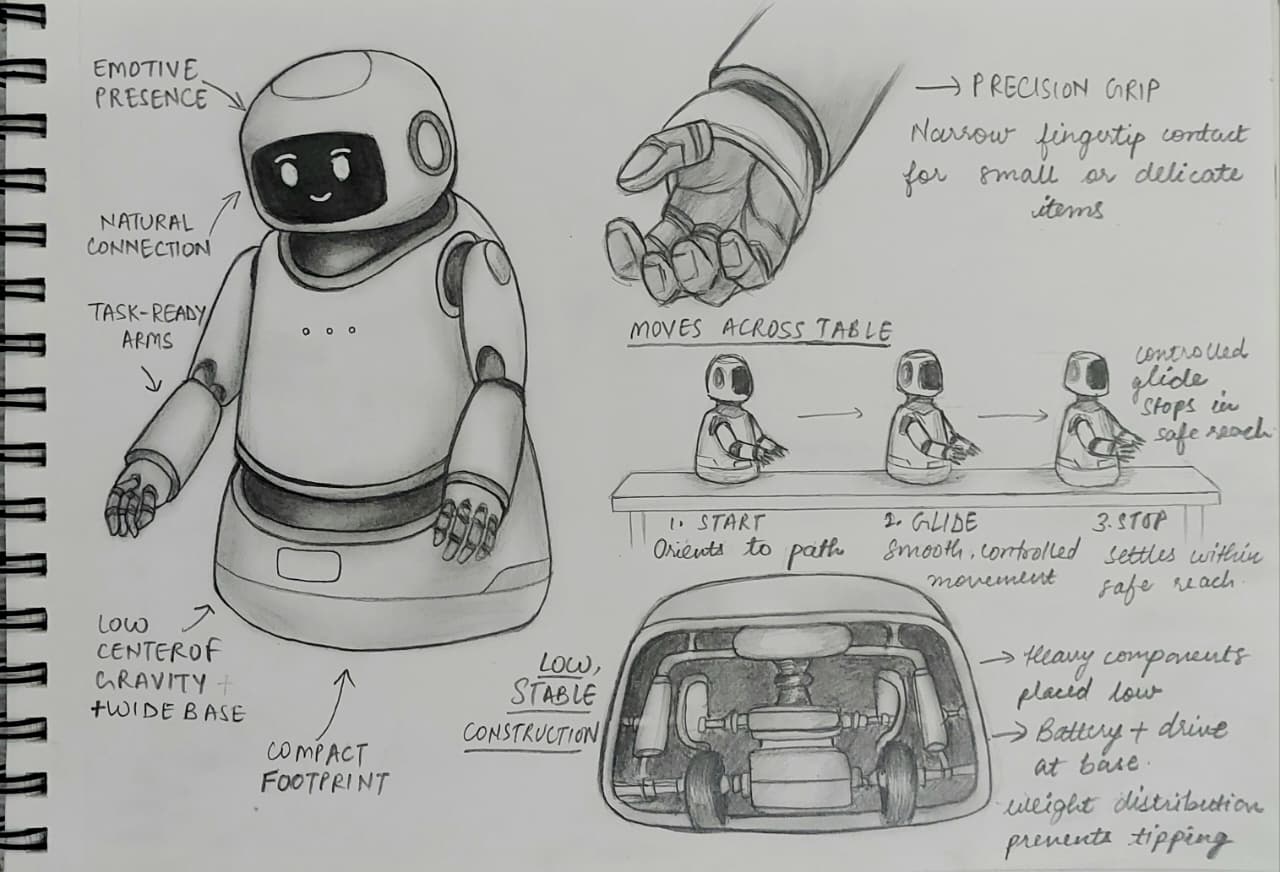
The physical form emerged from balancing assistive intelligence with emotional comfort and everyday coexistence.
The physical form emerged from balancing assistive intelligence with emotional comfort and everyday coexistence.
The physical form emerged from balancing assistive intelligence with emotional comfort and everyday coexistence.
The structure was shaped around how the system needed to move, assist, communicate presence, and exist within home environments without feeling intrusive. Posture, proportions, movement behavior, reach, and visual softness were explored to make the robot feel approachable, stable, and emotionally reassuring during everyday care interactions.
The structure was shaped around how the system needed to move, assist, communicate presence, and exist within home environments without feeling intrusive. Posture, proportions, movement behavior, reach, and visual softness were explored to make the robot feel approachable, stable, and emotionally reassuring during everyday care interactions.
The structure was shaped around how the system needed to move, assist, communicate presence, and exist within home environments without feeling intrusive. Posture, proportions, movement behavior, reach, and visual softness were explored to make the robot feel approachable, stable, and emotionally reassuring during everyday care interactions.


INTRODUCING SAATHI
INTRODUCING SAATHI
INTRODUCING SAATHI
Saathi was visually designed to feel emotionally reassuring before feeling technologically intelligent.
Saathi was visually designed to feel emotionally reassuring before feeling technologically intelligent.
Saathi was visually designed to feel emotionally reassuring before feeling technologically intelligent.
The visual language focused on reducing intimidation and creating a softer social presence within home environments. Neutral tones helped the system blend naturally into everyday spaces, while subtle purple illumination introduced a sense of calm responsiveness without becoming visually demanding or clinically harsh.
The visual language focused on reducing intimidation and creating a softer social presence within home environments. Neutral tones helped the system blend naturally into everyday spaces, while subtle purple illumination introduced a sense of calm responsiveness without becoming visually demanding or clinically harsh.
The visual language focused on reducing intimidation and creating a softer social presence within home environments. Neutral tones helped the system blend naturally into everyday spaces, while subtle purple illumination introduced a sense of calm responsiveness without becoming visually demanding or clinically harsh.

APP CONNECTIVITY
APP CONNECTIVITY
APP CONNECTIVITY
Adaptive assistance started demanding a layer that could carry routines, updates, and care coordination beyond physical interaction moments alone.
Adaptive assistance started demanding a layer that could carry routines, updates, and care coordination beyond physical interaction moments alone.
Adaptive assistance started demanding a layer that could carry routines, updates, and care coordination beyond physical interaction moments alone.
As medication behavior kept shifting through dosage changes, medicine replacements, caregiver involvement, and routine adjustments, the ecosystem needed continuity outside direct interaction spaces. The app became the connected layer that allowed these evolving decisions and updates to remain synchronized with SAATHI’s adaptive behavior.
As medication behavior kept shifting through dosage changes, medicine replacements, caregiver involvement, and routine adjustments, the ecosystem needed continuity outside direct interaction spaces. The app became the connected layer that allowed these evolving decisions and updates to remain synchronized with SAATHI’s adaptive behavior.
As medication behavior kept shifting through dosage changes, medicine replacements, caregiver involvement, and routine adjustments, the ecosystem needed continuity outside direct interaction spaces. The app became the connected layer that allowed these evolving decisions and updates to remain synchronized with SAATHI’s adaptive behavior.

MOCKUPS & INTERACTIONS
MOCKUPS & INTERACTIONS
MOCKUPS & INTERACTIONS
The interaction flow was designed around a simple shift in responsibility: the system should do more of the managing so the user has to do less of the coping.
The interaction flow was designed around a simple shift in responsibility: the system should do more of the managing so the user has to do less of the coping.
The interaction flow was designed around a simple shift in responsibility: the system should do more of the managing so the user has to do less of the coping.
Instead of forcing users to constantly track changes, recover from disruptions, or manually reorganize routines, the experience absorbed evolving schedules, interventions, and contextual shifts in the background. This allowed care interactions to feel lighter, calmer, and less mentally demanding across everyday use.
Instead of forcing users to constantly track changes, recover from disruptions, or manually reorganize routines, the experience absorbed evolving schedules, interventions, and contextual shifts in the background. This allowed care interactions to feel lighter, calmer, and less mentally demanding across everyday use.
Instead of forcing users to constantly track changes, recover from disruptions, or manually reorganize routines, the experience absorbed evolving schedules, interventions, and contextual shifts in the background. This allowed care interactions to feel lighter, calmer, and less mentally demanding across everyday use.

TAKEAWAY
TAKEAWAY
TAKEAWAY
The deeper SAATHI evolved, the more every layer of the ecosystem started influencing the meaning of the others.
The deeper SAATHI evolved, the more every layer of the ecosystem started influencing the meaning of the others.
The deeper SAATHI evolved, the more every layer of the ecosystem started influencing the meaning of the others.
While experimenting with Persona Bot, I stepped into vibe-coding workflows, GitHub repositories, and deployment systems to explore interaction possibilities beyond conventional UX processes. As the project expanded further, the bigger realization came from understanding how embodiment, adaptive behaviour, emotional presence, physical interaction, and digital continuity continuously shape one another beneath the surface of the experience of a product's ecosystem.
While experimenting with Persona Bot, I stepped into vibe-coding workflows, GitHub repositories, and deployment systems to explore interaction possibilities beyond conventional UX processes. As the project expanded further, the bigger realization came from understanding how embodiment, adaptive behaviour, emotional presence, physical interaction, and digital continuity continuously shape one another beneath the surface of the experience of a product's ecosystem.
While experimenting with Persona Bot, I stepped into vibe-coding workflows, GitHub repositories, and deployment systems to explore interaction possibilities beyond conventional UX processes. As the project expanded further, the bigger realization came from understanding how embodiment, adaptive behaviour, emotional presence, physical interaction, and digital continuity continuously shape one another beneath the surface of the experience of a product's ecosystem.

Nexu
AI Aggregator

Aegis
Product Design