
October - December 2025
Nexu
Nexu
Nexu
A centralized AI aggregator that converts user intent into optimized prompts, routes them to the most suitable AI tool while considering real-time demand, directing tasks toward less crowded models to balance load and manage energy consumption.
Industry
Generative AI
Scope of work
UX Research & Interaction Design
Duration
3 months
A centralized AI aggregator that converts user intent into optimized prompts, routes them to the most suitable AI tool while considering real-time demand, targeting a 65% reduction in redundant AI processing while balancing computational load across models.
Industry
Industry
Generative AI
Generative AI
Scope of work
Scope of work
UX Research & Interaction Design
UX Research & Interaction Design
Duration
Duration
3 months
3 months
" This project did not begin with a clearly defined problem. It began with curiosity. While exploring AI as a rapidly evolving field, I started brainstorming its less visible and less discussed dimensions. Most conversations revolved around capability and speed, but little attention seemed to be given to the behavioural and systemic consequences of everyday use. That curiosity led me into research without a fixed conclusion in mind. Progressively, a new problem space revealed itself: one that I had not anticipated at the outset. "
" This project did not begin with a clearly defined problem. It began with curiosity. While exploring AI as a rapidly evolving field, I started brainstorming its less visible and less discussed dimensions. Most conversations revolved around capability and speed, but little attention seemed to be given to the behavioural and systemic consequences of everyday use. That curiosity led me into research without a fixed conclusion in mind. Progressively, a new problem space revealed itself: one that I had not anticipated at the outset. "


PROBLEM
PROBLEM
PROBLEM
Everyday AI use is fragmented and excessive, driven by efficiency that encourages repeated tool-switching & habitual reliance causing over-consumption of energy.
Everyday AI use is fragmented and excessive, driven by efficiency that encourages repeated tool-switching & habitual reliance causing over-consumption of energy.
Everyday AI use is fragmented and excessive, driven by efficiency that encourages repeated tool-switching & habitual reliance causing over-consumption of energy.
AI tasks are often completed across multiple platforms, requiring users to rewrite prompts, regenerate outputs, and compare results manually. Because switching tools is fast and effortless, users repeat interactions across systems rather than refining intent within one flow. This pattern of parallel usage increases total AI calls and amplifies backend energy demand. Over time, fragmented workflows and habitual retries accumulate into unnecessary computational load, scaling energy consumption beyond what the task originally required.
AI tasks are often completed across multiple platforms, requiring users to rewrite prompts, regenerate outputs, and compare results manually. Because switching tools is fast and effortless, users repeat interactions across systems rather than refining intent within one flow. This pattern of parallel usage increases total AI calls and amplifies backend energy demand. Over time, fragmented workflows and habitual retries accumulate into unnecessary computational load, scaling energy consumption beyond what the task originally required.
AI tasks are often completed across multiple platforms, requiring users to rewrite prompts, regenerate outputs, and compare results manually. Because switching tools is fast and effortless, users repeat interactions across systems rather than refining intent within one flow. This pattern of parallel usage increases total AI calls and amplifies backend energy demand. Over time, fragmented workflows and habitual retries accumulate into unnecessary computational load, scaling energy consumption beyond what the task originally required.

LITERATURE SYNTHESIS
LITERATURE SYNTHESIS
LITERATURE SYNTHESIS
AI efficiency gains often lead to increased overall usage, unintentionally amplifying environmental impact rather than reducing it.
AI efficiency gains often lead to increased overall usage, unintentionally amplifying environmental impact rather than reducing it.
AI efficiency gains often lead to increased overall usage, unintentionally amplifying environmental impact rather than reducing it.
Think of AI as a perfectly efficient elevator in a busy building. It saves time, effort, and energy, so people start using it more, even for trips they once took the stairs for. Over time, the total number of rides increases so much that the building ends up consuming more energy than before.
This is the essence of Jevons Paradox, when a technology becomes more efficient, its convenience often leads to increased overall consumption rather than reduction. In the context of AI, this manifests as the Rebound Effect, where faster responses and lower friction encourage more frequent interactions, offsetting any intended efficiency gains.
Think of AI as a perfectly efficient elevator in a busy building. It saves time, effort, and energy, so people start using it more, even for trips they once took the stairs for. Over time, the total number of rides increases so much that the building ends up consuming more energy than before.
This is the essence of Jevons Paradox, when a technology becomes more efficient, its convenience often leads to increased overall consumption rather than reduction. In the context of AI, this manifests as the Rebound Effect, where faster responses and lower friction encourage more frequent interactions, offsetting any intended efficiency gains.
Think of AI as a perfectly efficient elevator in a busy building. It saves time, effort, and energy, so people start using it more, even for trips they once took the stairs for. Over time, the total number of rides increases so much that the building ends up consuming more energy than before.
This is the essence of Jevons Paradox, when a technology becomes more efficient, its convenience often leads to increased overall consumption rather than reduction. In the context of AI, this manifests as the Rebound Effect, where faster responses and lower friction encourage more frequent interactions, offsetting any intended efficiency gains.

GAPS IDENTIFIED
GAPS IDENTIFIED
GAPS IDENTIFIED
What is missing is recognition of how efficiency, dependency, and hidden impact operate as a single reinforcing loop.
What is missing is recognition of how efficiency, dependency, and hidden impact operate as a single reinforcing loop.
What is missing is recognition of how efficiency, dependency, and hidden impact operate as a single reinforcing loop.
While rebound effect, psychological dependency, and environmental cost are individually acknowledged in research, they are rarely examined together within real AI workflows. When viewed collectively, they reveal a reinforcing loop shaped by frictionless design and habitual interaction. The gap lies in the absence of a unified framework that explains how interface decisions influence user behaviour, and how that behaviour scales infrastructural impact over time.
While rebound effect, psychological dependency, and environmental cost are individually acknowledged in research, they are rarely examined together within real AI workflows. When viewed collectively, they reveal a reinforcing loop shaped by frictionless design and habitual interaction. The gap lies in the absence of a unified framework that explains how interface decisions influence user behaviour, and how that behaviour scales infrastructural impact over time.
While rebound effect, psychological dependency, and environmental cost are individually acknowledged in research, they are rarely examined together within real AI workflows. When viewed collectively, they reveal a reinforcing loop shaped by frictionless design and habitual interaction. The gap lies in the absence of a unified framework that explains how interface decisions influence user behaviour, and how that behaviour scales infrastructural impact over time.

BEHAVIOURAL VALIDATION
BEHAVIOURAL VALIDATION
BEHAVIOURAL VALIDATION
User responses reveal habitual AI use accompanied by rising emotional reliance & limited awareness of its broader implications.
User responses reveal habitual AI use accompanied by rising emotional reliance & limited awareness of its broader implications.
User responses reveal habitual AI use accompanied by rising emotional reliance & limited awareness of its broader implications.
The survey was conducted via Google Form with a sample size of 36 to examine AI usage frequency, emotional reliance, and awareness levels to capture real user behaviours and perceptions. This approach complemented the literature by grounding the research in everyday AI interaction patterns.
The survey was conducted via Google Form with a sample size of 36 to examine AI usage frequency, emotional reliance, and awareness levels to capture real user behaviours and perceptions. This approach complemented the literature by grounding the research in everyday AI interaction patterns.
The survey was conducted via Google Form with a sample size of 36 to examine AI usage frequency, emotional reliance, and awareness levels to capture real user behaviours and perceptions. This approach complemented the literature by grounding the research in everyday AI interaction patterns.


IDEATION
IDEATION
IDEATION
The core decision was to intervene at the moment of intent formation rather than after AI output is generated.
The core decision was to intervene at the moment of intent formation rather than after AI output is generated.
The core decision was to intervene at the moment of intent formation rather than after AI output is generated.
Early exploration pushed in multiple directions: restriction felt forceful, awareness alone felt passive, and post-use reflection felt too late. The real friction point was unclear. The breakthrough came in recognizing that behaviour is shaped at the moment of prompt formation. From there, the direction became less about adding features and more about reorganizing interaction flow. It also revealed that clearer prompt structuring at entry could reduce the need for repeated prompts, minimizing unnecessary iterations before execution.
Early exploration pushed in multiple directions: restriction felt forceful, awareness alone felt passive, and post-use reflection felt too late. The real friction point was unclear. The breakthrough came in recognizing that behaviour is shaped at the moment of prompt formation. From there, the direction became less about adding features and more about reorganizing interaction flow. It also revealed that clearer prompt structuring at entry could reduce the need for repeated prompts, minimizing unnecessary iterations before execution.
Early exploration pushed in multiple directions: restriction felt forceful, awareness alone felt passive, and post-use reflection felt too late. The real friction point was unclear. The breakthrough came in recognizing that behaviour is shaped at the moment of prompt formation. From there, the direction became less about adding features and more about reorganizing interaction flow. It also revealed that clearer prompt structuring at entry could reduce the need for repeated prompts, minimizing unnecessary iterations before execution.

COMPETITIVE ANALYSIS
COMPETITIVE ANALYSIS
COMPETITIVE ANALYSIS
The market has optimized AI performance, not the behaviour that precedes it.
The market has optimized AI performance, not the behaviour that precedes it.
The market has optimized AI performance, not the behaviour that precedes it.
Most platforms compete on model capability, speed, and access. They assume that once output improves, experience improves. However, prompt entry remains unstructured, iteration remains user-managed, and tool switching remains external to the system. The ecosystem accelerates execution but does not guide intention. This reveals a structural opportunity: to intervene not at output, but at the moment users decide how to ask.
Most platforms compete on model capability, speed, and access. They assume that once output improves, experience improves. However, prompt entry remains unstructured, iteration remains user-managed, and tool switching remains external to the system. The ecosystem accelerates execution but does not guide intention. This reveals a structural opportunity: to intervene not at output, but at the moment users decide how to ask.
Most platforms compete on model capability, speed, and access. They assume that once output improves, experience improves. However, prompt entry remains unstructured, iteration remains user-managed, and tool switching remains external to the system. The ecosystem accelerates execution but does not guide intention. This reveals a structural opportunity: to intervene not at output, but at the moment users decide how to ask.

DESIGN GOAL
DESIGN GOAL
DESIGN GOAL
Transform AI interaction from tool-centric usage to intent-centric execution.
Transform AI interaction from tool-centric usage to intent-centric execution.
Transform AI interaction from tool-centric usage to intent-centric execution.
The focus was to reduce the cognitive responsibility of selecting, adapting, and managing AI systems while preserving transparency and control. This created an opportunity to investigate how orchestration, optimization, and execution could occur in the background, allowing the interaction to center around user goals rather than system mechanics.
The focus was to reduce the cognitive responsibility of selecting, adapting, and managing AI systems while preserving transparency and control. This created an opportunity to investigate how orchestration, optimization, and execution could occur in the background, allowing the interaction to center around user goals rather than system mechanics.
The focus was to reduce the cognitive responsibility of selecting, adapting, and managing AI systems while preserving transparency and control. This created an opportunity to investigate how orchestration, optimization, and execution could occur in the background, allowing the interaction to center around user goals rather than system mechanics.
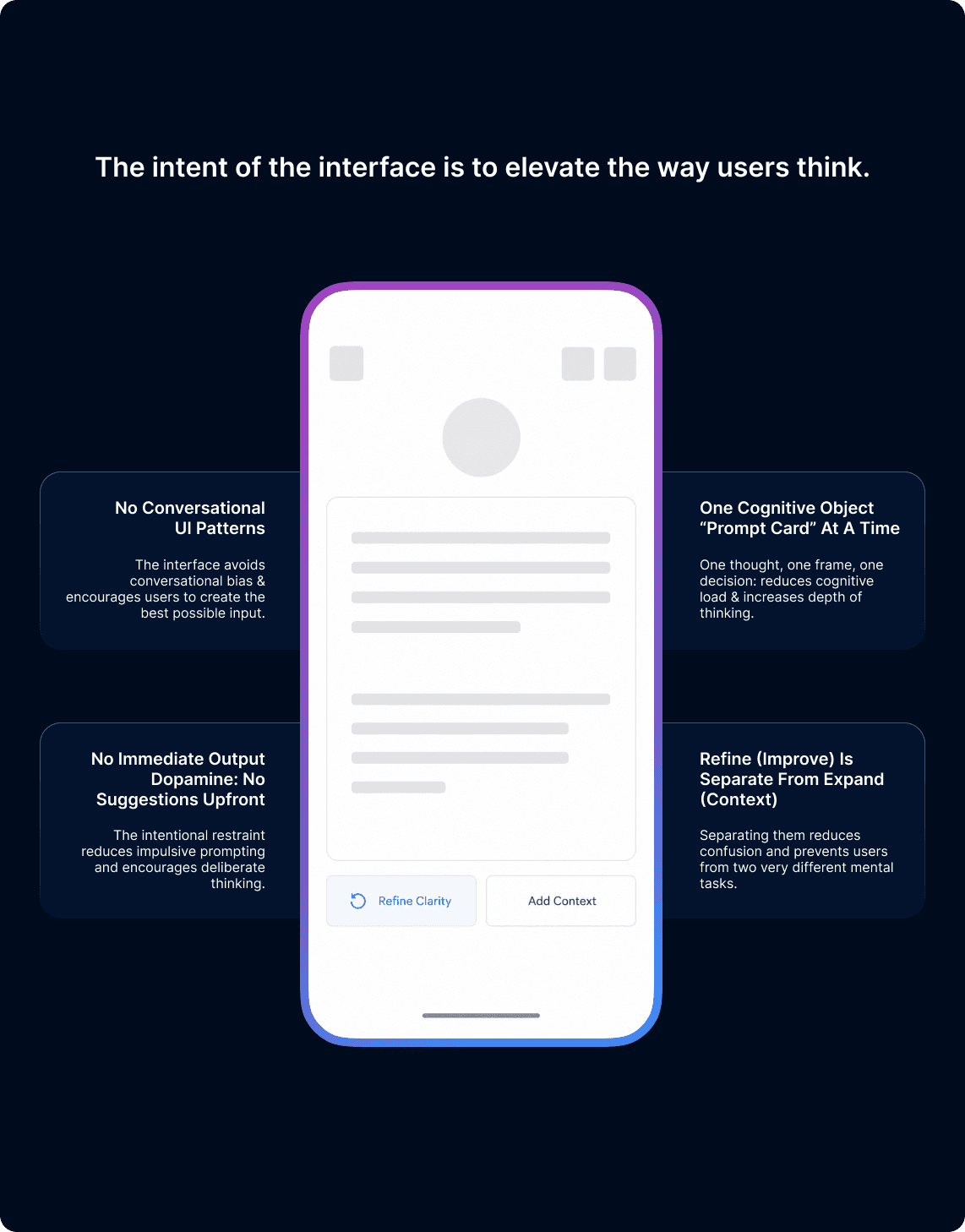

WIREFLOW
WIREFLOW
WIREFLOW
The interaction is deliberately sequenced to structure intent, validate clarity, and stabilize input before any external AI execution occurs.
The interaction is deliberately sequenced to structure intent, validate clarity, and stabilize input before any external AI execution occurs.
The interaction is deliberately sequenced to structure intent, validate clarity, and stabilize input before any external AI execution occurs.
Users progress from prompt entry into guided refinement, where clarity and context are shaped before routing is triggered. A conditional checkpoint prevents premature execution, ensuring that iteration happens within the system rather than across multiple external tools. Only once the prompt reaches structural stability does the system interpret and match it to the most suitable AI environment. The design prioritizes intention over speed, turning execution into a controlled outcome rather than a reflex.
Users progress from prompt entry into guided refinement, where clarity and context are shaped before routing is triggered. A conditional checkpoint prevents premature execution, ensuring that iteration happens within the system rather than across multiple external tools. Only once the prompt reaches structural stability does the system interpret and match it to the most suitable AI environment. The design prioritizes intention over speed, turning execution into a controlled outcome rather than a reflex.
Users progress from prompt entry into guided refinement, where clarity and context are shaped before routing is triggered. A conditional checkpoint prevents premature execution, ensuring that iteration happens within the system rather than across multiple external tools. Only once the prompt reaches structural stability does the system interpret and match it to the most suitable AI environment. The design prioritizes intention over speed, turning execution into a controlled outcome rather than a reflex.

INTRODUCING NEXU
INTRODUCING NEXU
INTRODUCING NEXU
A centralized AI aggregator that converts user intent into optimized prompts, routes them to relevant AI tools.
A centralized AI aggregator that converts user intent into optimized prompts, routes them to relevant AI tools.
A centralized AI aggregator that converts user intent into optimized prompts, routes them to relevant AI tools.
The platform interprets the task, restructures the prompt for clarity or context, and routes it to the most suitable AI model in the background, reducing the need for users to manually test the same prompt across multiple tools. The system routes prompts to the most suitable AI tool while considering real-time demand, directing tasks toward less crowded models to balance load and manage energy consumption. A floating action control remains visible on the interface, allowing users to switch tools if they need alternatives.
The platform interprets the task, restructures the prompt for clarity or context, and routes it to the most suitable AI model in the background, reducing the need for users to manually test the same prompt across multiple tools. The system routes prompts to the most suitable AI tool while considering real-time demand, directing tasks toward less crowded models to balance load and manage energy consumption. A floating action control remains visible on the interface, allowing users to switch tools if they need alternatives.
The platform interprets the task, restructures the prompt for clarity or context, and routes it to the most suitable AI model in the background, reducing the need for users to manually test the same prompt across multiple tools. The system routes prompts to the most suitable AI tool while considering real-time demand, directing tasks toward less crowded models to balance load and manage energy consumption. A floating action control remains visible on the interface, allowing users to switch tools if they need alternatives.



POTENTIAL IMPACT
POTENTIAL IMPACT
POTENTIAL IMPACT
Nexu’s impact lies in restructuring AI interaction at the behavioural, systemic, and environmental levels simultaneously.
Nexu’s impact lies in restructuring AI interaction at the behavioural, systemic, and environmental levels simultaneously.
Nexu’s impact lies in restructuring AI interaction at the behavioural, systemic, and environmental levels simultaneously.
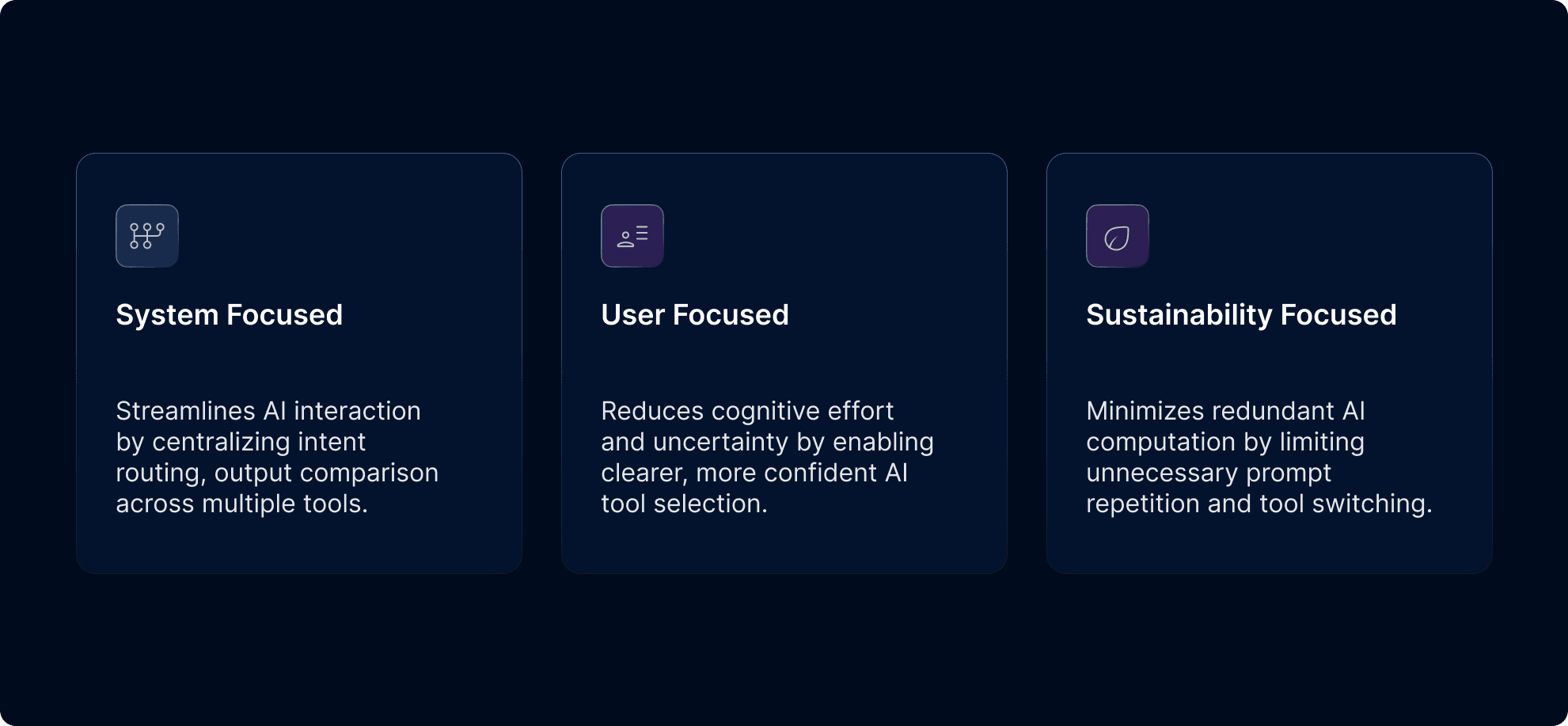
Users benefit from clearer decision-making and lower cognitive load, while the infrastructure benefits from fewer redundant computations caused by repetitive tool switching. The impact is not limited to usability improvements; it extends to how AI is consumed at scale, demonstrating that thoughtful interaction design can influence both human behaviour and system efficiency.
Users benefit from clearer decision-making and lower cognitive load, while the infrastructure benefits from fewer redundant computations caused by repetitive tool switching. The impact is not limited to usability improvements; it extends to how AI is consumed at scale, demonstrating that thoughtful interaction design can influence both human behaviour and system efficiency.
Users benefit from clearer decision-making and lower cognitive load, while the infrastructure benefits from fewer redundant computations caused by repetitive tool switching. The impact is not limited to usability improvements; it extends to how AI is consumed at scale, demonstrating that thoughtful interaction design can influence both human behaviour and system efficiency.
TAKEAWAY & FAILURE POINTS
TAKEAWAY & FAILURE POINTS
TAKEAWAY & FAILURE POINTS
This project strengthened my ability to approach AI design challenges through a balance of research rigor, system thinking, and user-centered decision making.
This project strengthened my ability to approach AI design challenges through a balance of research rigor, system thinking, and user-centered decision making.
This project strengthened my ability to approach AI design challenges through a balance of research rigor, system thinking, and user-centered decision making.
Limited validation of the AR experience centre: Due to time and resource constraints, the experiential layer was not tested with users, leaving its long-term effectiveness as an awareness tool unverified.
Assumptions in tool-routing logic: The aggregation and matching logic is conceptually defined but not backed by real-time model performance data, which may impact accuracy at scale.
Limited validation of the AR experience centre: Due to time and resource constraints, the experiential layer was not tested with users, leaving its long-term effectiveness as an awareness tool unverified.
Assumptions in tool-routing logic: The aggregation and matching logic is conceptually defined but not backed by real-time model performance data, which may impact accuracy at scale.
Limited validation of the AR experience centre: Due to time and resource constraints, the experiential layer was not tested with users, leaving its long-term effectiveness as an awareness tool unverified.
Assumptions in tool-routing logic: The aggregation and matching logic is conceptually defined but not backed by real-time model performance data, which may impact accuracy at scale.

Aegis
Product Design

JalMaarg
Ethnographic Research