
September - November 2025
Aegis
Aegis
Aegis
A gender-inclusive and discreet pen-based personal safety system designed for situations in closed spaces where speed, discretion and physical response matter more than screens, reducing interaction steps by up to 85% during emergency activation.
Industry
Industry
Personal Safety Tech
Personal Safety Tech
Scope of work
Scope of work
Product Design
Product Design
Duration
Duration
2 months
2 months
A gender-inclusive and discreet pen-based personal safety system designed for situations in closed spaces where speed, discretion, and physical response matter more than screens.
Industry
Personal Safety Tech
Scope of work
Product Design
Duration
2 months
" Surrounded by constant safety-related news, I began paying closer attention to how people react in uncomfortable situations: the hesitation to pull out a phone, the instinct to stay unnoticed, the need to regain control quickly rather than document what is happening. These observations led me to question how safety tools could exist within the moment itself. "
" Surrounded by constant safety-related news, I began paying closer attention to how people react in uncomfortable situations: the hesitation to pull out a phone, the instinct to stay unnoticed, the need to regain control quickly rather than document what is happening. These observations led me to question how safety tools could exist within the moment itself. "
" Surrounded by constant safety-related news, I began paying closer attention to how people react in uncomfortable situations: the hesitation to pull out a phone, the instinct to stay unnoticed, the need to regain control quickly rather than document what is happening. These observations led me to question how safety tools could exist within the moment itself. "


PROBLEM
PROBLEM
PROBLEM
Individuals’ sense of safety & control is undermined in confined spaces.
Individuals’ sense of safety & control is undermined in confined spaces.
Individuals’ sense of safety & control is undermined in confined spaces.
In India, everyday spaces often carry unspoken risks, and rising incidents of harassment continue to expose the limitations of existing safety measures. These moments highlight the need to understand how individuals across genders experience vulnerability in close, low-visibility settings.
In India, everyday spaces often carry unspoken risks, and rising incidents of harassment continue to expose the limitations of existing safety measures. These moments highlight the need to understand how individuals across genders experience vulnerability in close, low-visibility settings.
In India, everyday spaces often carry unspoken risks, and rising incidents of harassment continue to expose the limitations of existing safety measures. These moments highlight the need to understand how individuals across genders experience vulnerability in close, low-visibility settings.

existing solutions
existing solutions
existing solutions
The ecosystem of safety tools is reactive-heavy, with limited proactive mechanisms to support users before or during escalation.
The ecosystem of safety tools is reactive-heavy, with limited proactive mechanisms to support users before or during escalation.
The ecosystem of safety tools is reactive-heavy, with limited proactive mechanisms to support users before or during escalation.
Safety features added to everyday objects such as phones, wearables, bags, or keychains often become visually apparent, reducing discretion, while trusted systems tied to these objects tend to respond only after an incident rather than during it.
Safety features added to everyday objects such as phones, wearables, bags, or keychains often become visually apparent, reducing discretion, while trusted systems tied to these objects tend to respond only after an incident rather than during it.
Safety features added to everyday objects such as phones, wearables, bags, or keychains often become visually apparent, reducing discretion, while trusted systems tied to these objects tend to respond only after an incident rather than during it.


mixed-method approach
mixed-method approach
mixed-method approach
Users default to avoidance & informal coping strategies, driven by cognitive overload & fear of escalation.
Users default to avoidance & informal coping strategies, driven by cognitive overload & fear of escalation.
Users default to avoidance & informal coping strategies, driven by cognitive overload & fear of escalation.
The survey captured how users respond when feeling unsafe and why existing safety tools are often avoided. Interviews unpacked the reasoning behind those choices, hesitation under pressure, fear of escalation, and low trust in systems that feel slow or complex. Impact-frequency mapping revealed a clear gap: safety fails not in intent, but in moments where fear, uncertainty and pressure to decide quickly co-exist.
The survey captured how users respond when feeling unsafe and why existing safety tools are often avoided. Interviews unpacked the reasoning behind those choices, hesitation under pressure, fear of escalation, and low trust in systems that feel slow or complex. Impact-frequency mapping revealed a clear gap: safety fails not in intent, but in moments where fear, uncertainty and pressure to decide quickly co-exist.
The survey captured how users respond when feeling unsafe and why existing safety tools are often avoided. Interviews unpacked the reasoning behind those choices, hesitation under pressure, fear of escalation, and low trust in systems that feel slow or complex. Impact-frequency mapping revealed a clear gap: safety fails not in intent, but in moments where fear, uncertainty and pressure to decide quickly co-exist.


users' snapshot
users' snapshot
users' snapshot
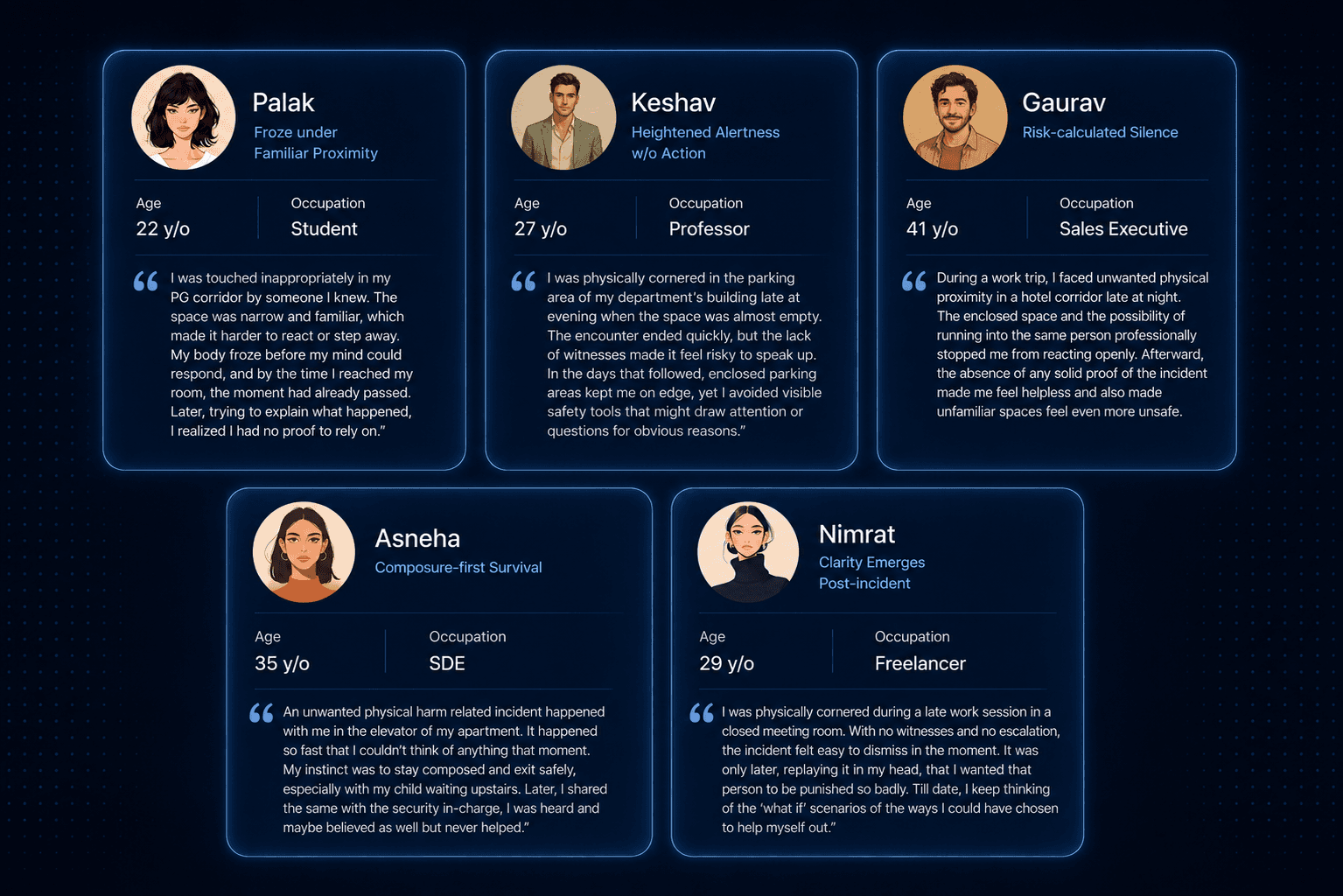
Harm in closed spaces is rarely loud or obvious, but its impact is immediate, isolating, and leaves users without the ability to respond or prove what happened.
Harm in closed spaces is rarely loud or obvious, but its impact is immediate, isolating, and leaves users without the ability to respond or prove what happened.
Harm in closed spaces is rarely loud or obvious, but its impact is immediate, isolating, and leaves users without the ability to respond or prove what happened.
Incidents occurred in familiar yet enclosed environments where reactions were constrained by shock, power dynamics, or fear of escalation. By the time users processed the incident, the moment had already passed and evidence was absent.
Incidents occurred in familiar yet enclosed environments where reactions were constrained by shock, power dynamics, or fear of escalation. By the time users processed the incident, the moment had already passed and evidence was absent.
Incidents occurred in familiar yet enclosed environments where reactions were constrained by shock, power dynamics, or fear of escalation. By the time users processed the incident, the moment had already passed and evidence was absent.
shaping the idea
shaping the idea
shaping the idea
The pen emerged as the final concept because it is the most socially invisible object that users already hold naturally, allowing safety activation to happen discreetly and reliably under stress.
The pen emerged as the final concept because it is the most socially invisible object that users already hold naturally, allowing safety activation to happen discreetly and reliably under stress.
The pen emerged as the final concept because it is the most socially invisible object that users already hold naturally, allowing safety activation to happen discreetly and reliably under stress.
During ideation, objects like e-wallets, pendants, bottles, coffee flasks, and chargers were explored, but most demanded visible effort, intentional access, or fine motor control: all unreliable under stress.
Ergonomic decisions accounted for shaky hands, reduced grip strength, and cognitive overload, shaping tactile cues, pressure-based activation, and a cylindrical form that works without visual focus, keeping safety interactions discreet and dependable when precision breaks down.
During ideation, objects like e-wallets, pendants, bottles, coffee flasks, and chargers were explored, but most demanded visible effort, intentional access, or fine motor control: all unreliable under stress.
Ergonomic decisions accounted for shaky hands, reduced grip strength, and cognitive overload, shaping tactile cues, pressure-based activation, and a cylindrical form that works without visual focus, keeping safety interactions discreet and dependable when precision breaks down.
During ideation, objects like e-wallets, pendants, bottles, coffee flasks, and chargers were explored, but most demanded visible effort, intentional access, or fine motor control: all unreliable under stress.
Ergonomic decisions accounted for shaky hands, reduced grip strength, and cognitive overload, shaping tactile cues, pressure-based activation, and a cylindrical form that works without visual focus, keeping safety interactions discreet and dependable when precision breaks down.


INTRODUCING AEGIS
INTRODUCING AEGIS
INTRODUCING AEGIS
Aegis, a gender-inclusive pen that merges technology & self defence, discreetly.
Aegis, a gender-inclusive pen that merges technology & self defence, discreetly.
Aegis, a gender-inclusive pen that merges technology & self defence, discreetly.
A pen-based personal safety system designed for situations in closed spaces where speed, discretion, and physical response matter more than screens. The pen functions as the primary point of action during an incident, while the mobile app exists only to retain and organise evidence once the situation is under control.
A pen-based personal safety system designed for situations in closed spaces where speed, discretion, and physical response matter more than screens. The pen functions as the primary point of action during an incident, while the mobile app exists only to retain and organise evidence once the situation is under control.
A pen-based personal safety system designed for situations in closed spaces where speed, discretion, and physical response matter more than screens. The pen functions as the primary point of action during an incident, while the mobile app exists only to retain and organise evidence once the situation is under control.


FEEDBACK SURVEY
FEEDBACK SURVEY
FEEDBACK SURVEY
Early feedback showed alignment with the concept direction, alongside uncertainties requiring refinement rather than rethinking.
Early feedback showed alignment with the concept direction, alongside uncertainties requiring refinement rather than rethinking.
Early feedback showed alignment with the concept direction, alongside uncertainties requiring refinement rather than rethinking.
The Maze survey captured how users interpreted the proposed safety system at first exposure. Responses showed that the core idea was generally understood and not perceived as intrusive or unrealistic. Neutral feedback clustered around questions of scope, edge cases, and situational fit, pointing to refinement opportunities instead of conceptual rejection.
The Maze survey captured how users interpreted the proposed safety system at first exposure. Responses showed that the core idea was generally understood and not perceived as intrusive or unrealistic. Neutral feedback clustered around questions of scope, edge cases, and situational fit, pointing to refinement opportunities instead of conceptual rejection.
The Maze survey captured how users interpreted the proposed safety system at first exposure. Responses showed that the core idea was generally understood and not perceived as intrusive or unrealistic. Neutral feedback clustered around questions of scope, edge cases, and situational fit, pointing to refinement opportunities instead of conceptual rejection.

TAKEAWAY
TAKEAWAY
TAKEAWAY
Aegis taught me that safety design is not about adding more features, it is about understanding people when they are at their most vulnerable.
Aegis taught me that safety design is not about adding more features, it is about understanding people when they are at their most vulnerable.
Aegis taught me that safety design is not about adding more features, it is about understanding people when they are at their most vulnerable.
Technical limitations exposed the gap between intended interactions and final implementation, but the bigger lesson came from observing human behaviour under stress. The project shifted my focus from designing for ideal scenarios to designing for real reactions: prioritising simplicity, discretion, and trust. In the end, Aegis became less about demanding attention and more about quietly stepping in when it matters most.
Technical limitations exposed the gap between intended interactions and final implementation, but the bigger lesson came from observing human behaviour under stress. The project shifted my focus from designing for ideal scenarios to designing for real reactions: prioritising simplicity, discretion, and trust. In the end, Aegis became less about demanding attention and more about quietly stepping in when it matters most.
Technical limitations exposed the gap between intended interactions and final implementation, but the bigger lesson came from observing human behaviour under stress. The project shifted my focus from designing for ideal scenarios to designing for real reactions: prioritising simplicity, discretion, and trust. In the end, Aegis became less about demanding attention and more about quietly stepping in when it matters most.

JalMaarg
Ethnographic Research

Saathi
Physical AI