
March- June 2026
March- June 2026
JalMaarg
JalMaarg
JalMaarg
A community-driven water management ecosystem that transforms fragmented reports, infrastructure data and field operations into a shared understanding, designed to reduce issue investigation time by 64% while enabling residents and coordinators to respond with clarity and confidence.
Industry
Industry
Rural Water System · Public Service Tech
Rural Water System · Public Service Tech
Scope of work
Scope of work
UX Research, UX Strategy & UX Design
UX Research, UX Strategy & UX Design
Duration
Duration
4 months
4 months
" Before visiting Kanatal, everything I knew about rural water management came from the outside looking in. Walking through the villages changed that. Every field visit challenged an assumption I didn't even know I had, reminding me that the goal wasn't to explain the village through my perspective, but to slowly replace it with theirs. "
" Before visiting Kanatal, everything I knew about rural water management came from the outside looking in. Walking through the villages changed that. Every field visit challenged an assumption I didn't even know I had, reminding me that the goal wasn't to explain the village through my perspective, but to slowly replace it with theirs. "
" Before visiting Kanatal, everything I knew about rural water management came from the outside looking in. Walking through the villages changed that. Every field visit challenged an assumption I didn't even know I had, reminding me that the goal wasn't to explain the village through my perspective, but to slowly replace it with theirs. "

A community-driven water management ecosystem that transforms fragmented reports, infrastructure data and field operations into a shared understanding, enabling both residents and coordinators to respond with clarity and confidence.
Industry
Rural Water System · Public Service Tech
Scope of work
UX Research, UX Strategy & UX Design
Duration
4 months

BACKGROUND
BACKGROUND
BACKGROUND
In Kanatal, geography, infrastructure, and livelihoods functioned as a single interconnected system.
In Kanatal, geography, infrastructure, and livelihoods functioned as a single interconnected system.
In Kanatal, geography, infrastructure, and livelihoods functioned as a single interconnected system.
Located in the Garhwal region, the village is characterised by steep topography, dispersed settlements, and a growing tourism economy alongside long-standing agricultural practices. Rather than existing independently, these conditions continually influenced one another, shaping how people moved, worked, accessed resources, and organised everyday life. Understanding these relationships required broad field immersion before narrowing the inquiry into a specific design opportunity.
Located in the Garhwal region, the village is characterised by steep topography, dispersed settlements, and a growing tourism economy alongside long-standing agricultural practices. Rather than existing independently, these conditions continually influenced one another, shaping how people moved, worked, accessed resources, and organised everyday life. Understanding these relationships required broad field immersion before narrowing the inquiry into a specific design opportunity.
Located in the Garhwal region, the village is characterised by steep topography, dispersed settlements, and a growing tourism economy alongside long-standing agricultural practices. Rather than existing independently, these conditions continually influenced one another, shaping how people moved, worked, accessed resources, and organised everyday life. Understanding these relationships required broad field immersion before narrowing the inquiry into a specific design opportunity.

my ROLE & REFLEXIVITY
my ROLE & REFLEXIVITY
my ROLE & REFLEXIVITY
Worked across field research, product strategy, and experience design, to translate field evidence into a cohesive solution.
Worked across field research, product strategy, and experience design, to translate field evidence into a cohesive solution.
Worked across field research, product strategy, and experience design, to translate field evidence into a cohesive solution.
Fieldwork demanded observing conversations, gestures, behaviours, and the surrounding environment simultaneously while remaining fully present in every interaction. Instead of documenting everything in the moment, I noted only keywords on-site and reconstructed detailed observations while walking between village segments, preserving context before it faded.
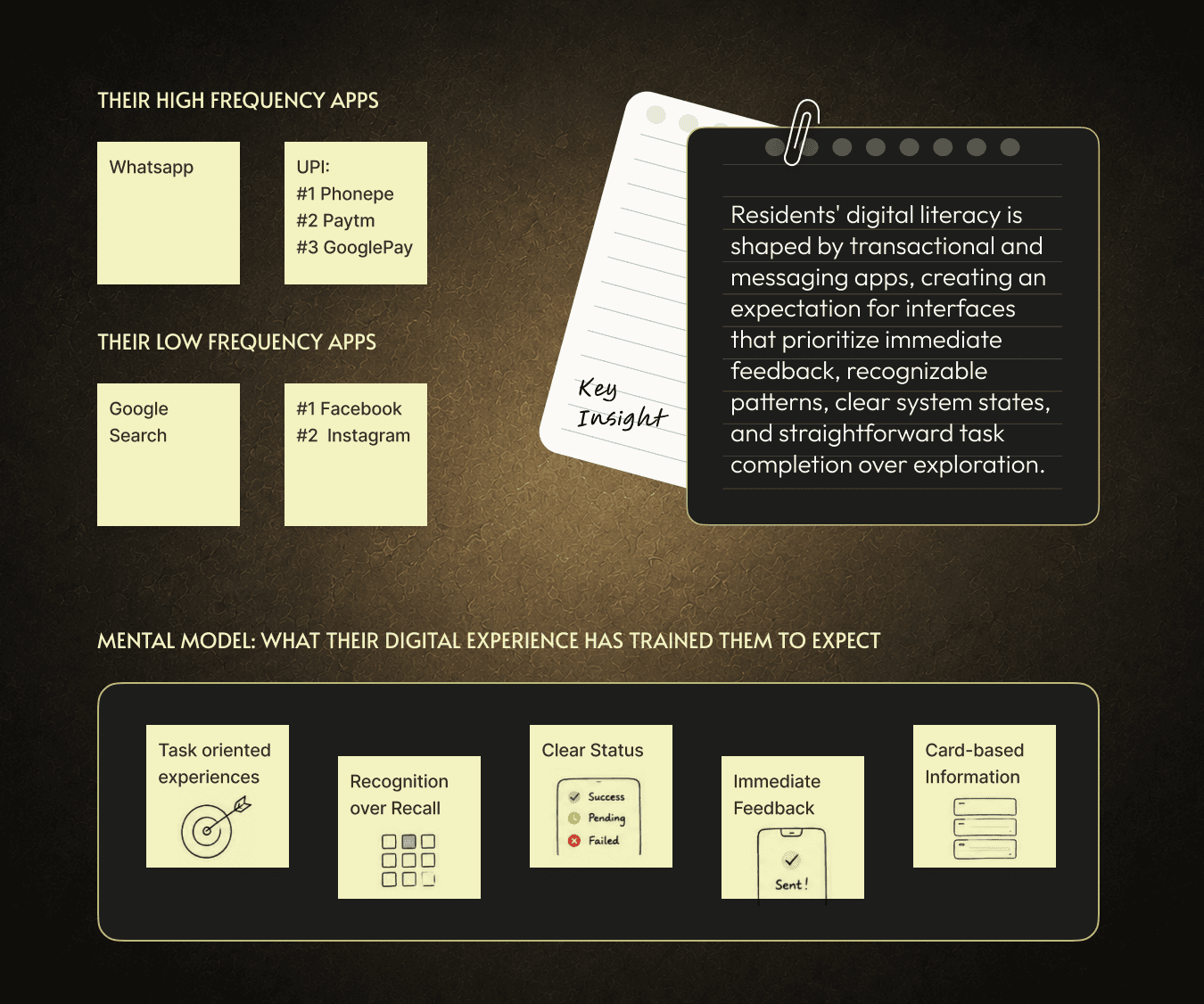
Having never experienced rural life first-hand, I was initially surprised by the community's familiarity with technology. Rather than validating assumptions shaped by an urban perspective, I consciously questioned them throughout the study, ensuring the research responded to realities that residents consistently demonstrated: not the gaps I expected to find.
Fieldwork demanded observing conversations, gestures, behaviours, and the surrounding environment simultaneously while remaining fully present in every interaction. Instead of documenting everything in the moment, I noted only keywords on-site and reconstructed detailed observations while walking between village segments, preserving context before it faded.
Having never experienced rural life first-hand, I was initially surprised by the community's familiarity with technology. Rather than validating assumptions shaped by an urban perspective, I consciously questioned them throughout the study, ensuring the research responded to realities that residents consistently demonstrated: not the gaps I expected to find.
Fieldwork demanded observing conversations, gestures, behaviours, and the surrounding environment simultaneously while remaining fully present in every interaction. Instead of documenting everything in the moment, I noted only keywords on-site and reconstructed detailed observations while walking between village segments, preserving context before it faded.
Having never experienced rural life first-hand, I was initially surprised by the community's familiarity with technology. Rather than validating assumptions shaped by an urban perspective, I consciously questioned them throughout the study, ensuring the research responded to realities that residents consistently demonstrated: not the gaps I expected to find.

RESEARCH APPROACH
RESEARCH APPROACH
RESEARCH APPROACH
Knowing the Unknown: Every stage was planned to progressively narrow the inquiry from broad observations to evidence-backed insights.
Knowing the Unknown: Every stage was planned to progressively narrow the inquiry from broad observations to evidence-backed insights.
Knowing the Unknown: Every stage was planned to progressively narrow the inquiry from broad observations to evidence-backed insights.
Each research method served a distinct purpose while informing the next. Peripheral participation established a contextual understanding of the village without prematurely narrowing the inquiry, allowing recurring environmental, behavioural, and social patterns to emerge naturally.
Observations gathered through shadowing then shaped the conversations explored during contextual inquiry, ensuring every subsequent research decision was grounded in evidence from the previous stage rather than assumption.
Each research method served a distinct purpose while informing the next. Peripheral participation established a contextual understanding of the village without prematurely narrowing the inquiry, allowing recurring environmental, behavioural, and social patterns to emerge naturally.
Observations gathered through shadowing then shaped the conversations explored during contextual inquiry, ensuring every subsequent research decision was grounded in evidence from the previous stage rather than assumption.
Each research method served a distinct purpose while informing the next. Peripheral participation established a contextual understanding of the village without prematurely narrowing the inquiry, allowing recurring environmental, behavioural, and social patterns to emerge naturally.
Observations gathered through shadowing then shaped the conversations explored during contextual inquiry, ensuring every subsequent research decision was grounded in evidence from the previous stage rather than assumption.

PERIPHERAL PHASE
PERIPHERAL PHASE
PERIPHERAL PHASE
The environment was influencing behaviour long before behaviour was ever observed.
The environment was influencing behaviour long before behaviour was ever observed.
The environment was influencing behaviour long before behaviour was ever observed.
It was uncovered that the underlying conditions quietly organised everyday life: from geography shaping mobility and livelihoods to local spaces evolving into shared social infrastructure. Rather than treating later observations as standalone behaviours, this broader understanding helped distinguish what people chose to do from what their environment continuously required them to do.
It was uncovered that the underlying conditions quietly organised everyday life: from geography shaping mobility and livelihoods to local spaces evolving into shared social infrastructure. Rather than treating later observations as standalone behaviours, this broader understanding helped distinguish what people chose to do from what their environment continuously required them to do.
It was uncovered that the underlying conditions quietly organised everyday life: from geography shaping mobility and livelihoods to local spaces evolving into shared social infrastructure. Rather than treating later observations as standalone behaviours, this broader understanding helped distinguish what people chose to do from what their environment continuously required them to do.


ACTIVE PHASE: SHADOWING
ACTIVE PHASE: SHADOWING
SHADOWING
The same terrain produced remarkably different constraints depending on who had to navigate it.
The same terrain produced remarkably different constraints depending on who had to navigate it.
The same terrain produced remarkably different constraints depending on who had to navigate it.
It was exposed that how a single environmental condition translated into distinct everyday experiences. While students adapted by walking long distances, farmers integrated the terrain into their livelihoods, and families navigated unpredictable access to transport and essential services. Observing these routines shifted our focus from geography itself to the unequal ways it shaped daily life.
It was exposed that how a single environmental condition translated into distinct everyday experiences. While students adapted by walking long distances, farmers integrated the terrain into their livelihoods, and families navigated unpredictable access to transport and essential services. Observing these routines shifted our focus from geography itself to the unequal ways it shaped daily life.
It was exposed that how a single environmental condition translated into distinct everyday experiences. While students adapted by walking long distances, farmers integrated the terrain into their livelihoods, and families navigated unpredictable access to transport and essential services. Observing these routines shifted our focus from geography itself to the unequal ways it shaped daily life.

ACTIVE PHASE: CONTEXTUAL INQUIRY
ACTIVE PHASE: CONTEXTUAL INQUIRY
CONTEXTUAL INQUIRY
Water scarcity emerges as the deeper systemic issue, with mobility becoming one of its consequences.
Water scarcity emerges as the deeper systemic issue, with mobility becoming one of its consequences.
Water scarcity emerges as the deeper systemic issue, with mobility becoming one of its consequences.
Conversations intentionally explored participants' routines. However, irrespective of where discussions began, participants consistently linked disruptions in farming, mobility, household responsibilities and daily planning to uncertain water availability. The recurrence of this dependency across unrelated contexts justified reframing water as the central focus for subsequent synthesis and design.
Conversations intentionally explored participants' routines. However, irrespective of where discussions began, participants consistently linked disruptions in farming, mobility, household responsibilities and daily planning to uncertain water availability. The recurrence of this dependency across unrelated contexts justified reframing water as the central focus for subsequent synthesis and design.
Conversations intentionally explored participants' routines. However, irrespective of where discussions began, participants consistently linked disruptions in farming, mobility, household responsibilities and daily planning to uncertain water availability. The recurrence of this dependency across unrelated contexts justified reframing water as the central focus for subsequent synthesis and design.

PROBLEM STATEMENT
PROBLEM STATEMENT
PROBLEM STATEMENT
Water access remained unpredictable, but the uncertainty surrounding it amplified its impact.
Water access remained unpredictable, but the uncertainty surrounding it amplified its impact.
Water access remained unpredictable, but the uncertainty surrounding it amplified its impact.
Residents, households, and businesses were not only responding to inconsistent supply but also to the absence of reliable information and coordinated communication. This constant uncertainty disrupted planning, increased dependency, and placed unnecessary effort into everyday activities that should have been routine.
Residents, households, and businesses were not only responding to inconsistent supply but also to the absence of reliable information and coordinated communication. This constant uncertainty disrupted planning, increased dependency, and placed unnecessary effort into everyday activities that should have been routine.
Residents, households, and businesses were not only responding to inconsistent supply but also to the absence of reliable information and coordinated communication. This constant uncertainty disrupted planning, increased dependency, and placed unnecessary effort into everyday activities that should have been routine.

FINALIZED IDEA
FINALIZED IDEA
FINALIZED IDEA
Lasting change required strengthening how people coordinated around water, not simply how they accessed it, through JalMaarg.
Lasting change required strengthening how people coordinated around water, not simply how they accessed it, through JalMaarg.
Lasting change required strengthening how people coordinated around water, not simply how they accessed it, through JalMaarg.
Water was never managed by a single stakeholder. Residents, local authorities, and community coordinators each held a fragment of the process, yet their interactions remained disconnected. JalMaarg consolidated these fragmented responsibilities into a shared community-driven service, enabling information, participation, and action to operate as one continuous system rather than independent efforts.
Water was never managed by a single stakeholder. Residents, local authorities, and community coordinators each held a fragment of the process, yet their interactions remained disconnected. JalMaarg consolidated these fragmented responsibilities into a shared community-driven service, enabling information, participation, and action to operate as one continuous system rather than independent efforts.
Water was never managed by a single stakeholder. Residents, local authorities, and community coordinators each held a fragment of the process, yet their interactions remained disconnected. JalMaarg consolidated these fragmented responsibilities into a shared community-driven service, enabling information, participation, and action to operate as one continuous system rather than independent efforts.

SERVICE BLUEPRINT
SERVICE BLUEPRINT
SERVICE BLUEPRINT
This shifted the design question from “What should each platform contain?” to “Who is responsible for sustaining each interaction?”
This shifted the design question from “What should each platform contain?” to “Who is responsible for sustaining each interaction?”
This shifted the design question from “What should each platform contain?” to “Who is responsible for sustaining each interaction?”
Viewing the service through responsibilities rather than interfaces redefined product boundaries. Features were allocated according to operational ownership, separating resident interactions from coordinator workflows while positioning Community as the shared communication bridge between both platforms. As a result, the resident experience remained intentionally simple without oversimplifying the service itself.
Viewing the service through responsibilities rather than interfaces redefined product boundaries. Features were allocated according to operational ownership, separating resident interactions from coordinator workflows while positioning Community as the shared communication bridge between both platforms. As a result, the resident experience remained intentionally simple without oversimplifying the service itself.
Viewing the service through responsibilities rather than interfaces redefined product boundaries. Features were allocated according to operational ownership, separating resident interactions from coordinator workflows while positioning Community as the shared communication bridge between both platforms. As a result, the resident experience remained intentionally simple without oversimplifying the service itself.


WEB EXPERIENCE
WEB EXPERIENCE
WEB EXPERIENCE
Every field decision depended on answers that lived somewhere else. The coordinator experience was designed to eliminate that search.
Every field decision depended on answers that lived somewhere else. The coordinator experience was designed to eliminate that search.
Every field decision depended on answers that lived somewhere else. The coordinator experience was designed to eliminate that search.
Rather than expecting coordinators to mentally connect infrastructure health, village conditions, previous interventions and community feedback, the interface progressively assembles them around the issue being investigated. As understanding deepens, each interaction reveals the next most relevant layer of information, allowing users to stay focused on resolving the problem instead of piecing it together.
Rather than expecting coordinators to mentally connect infrastructure health, village conditions, previous interventions and community feedback, the interface progressively assembles them around the issue being investigated. As understanding deepens, each interaction reveals the next most relevant layer of information, allowing users to stay focused on resolving the problem instead of piecing it together.
Rather than expecting coordinators to mentally connect infrastructure health, village conditions, previous interventions and community feedback, the interface progressively assembles them around the issue being investigated. As understanding deepens, each interaction reveals the next most relevant layer of information, allowing users to stay focused on resolving the problem instead of piecing it together.

MOBILE APP
MOBILE APP
MOBILE APP
Users don't build trust in public services through promises, they build it through predictable interactions.
Users don't build trust in public services through promises, they build it through predictable interactions.
Users don't build trust in public services through promises, they build it through predictable interactions.
The experience for residents translates this insight into every touchpoint. Information is organized around residents' immediate concerns, reporting mirrors the simplicity of familiar everyday apps, and every update remains visible as issues progress. By replacing uncertainty with continuous feedback, the interface helps residents feel informed, heard and confident that their participation leads to meaningful action.
The experience for residents translates this insight into every touchpoint. Information is organized around residents' immediate concerns, reporting mirrors the simplicity of familiar everyday apps, and every update remains visible as issues progress. By replacing uncertainty with continuous feedback, the interface helps residents feel informed, heard and confident that their participation leads to meaningful action.
The experience for residents translates this insight into every touchpoint. Information is organized around residents' immediate concerns, reporting mirrors the simplicity of familiar everyday apps, and every update remains visible as issues progress. By replacing uncertainty with continuous feedback, the interface helps residents feel informed, heard and confident that their participation leads to meaningful action.

ACTIONABLE NEXT STEP
User Testing: The true measure of JalMaarg lies in how confidently it fits into the routines it was designed to support.
User Testing: The true measure of JalMaarg lies in how confidently it fits into the routines it was designed to support.
User Testing: The true measure of JalMaarg lies in how confidently it fits into the routines it was designed to support.
Evaluate how naturally residents and coordinators integrate JalMaarg into their existing routines through moderated usability testing and contextual field trials.
Measure whether the shared ecosystem reduces uncertainty, strengthens trust and shortens the time required to understand and respond to water-related issues.
Refine interaction patterns through iterative testing, allowing real-world usage to shape future versions of both the resident and coordinator experiences.

Saathi
Physical AI

Nexu
AI Aggregator